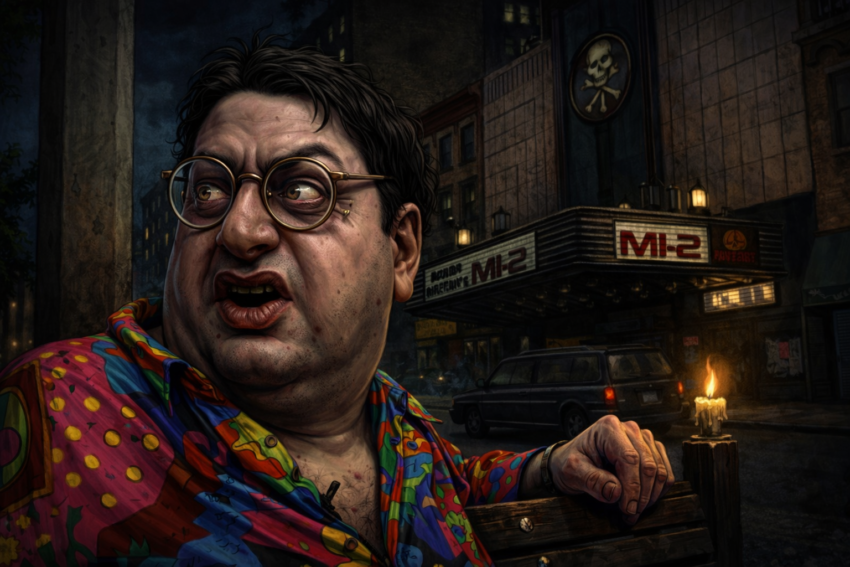
By virtue of his poor intellectual formation, the atheist has learned one habit of mind, that of doubting everything. For decades, with disciplined consistency, he has applied this deconstructive method to everything, stripping away belief after belief until nothing remained but his atheism. Yet he found even his atheism vulnerable, so much so that he was driven toward the denial of reality itself.
Consider Jack, an amalgamation of atheists I’ve encountered over the years.
Jack is a man who prides himself on his razor-sharp skepticism. He began, as so many do, by doubting the “fairy tales of childhood religion.” God, miracles, objective morality, all dismissed as comforting illusions. He devoured analytic philosophy, wielding nominalism like a scalpel: words are mere labels, he insisted, there are no universals, no external realities anchoring language or ethics. Everything reduces to individual preferences, power games, or arbitrary social constructs. The world, he argues, is just molecules in motion, and any claim to deeper meaning is a category error.
This method serves him well in his endless online debates with theists. From his childhood bedroom in his mother’s house, which he still inhabits, though he insists he “owns” it outright after “inheriting a small fortune and investing wisely,” Jack trains legions of impressionable young atheists. Many come from broken homes, hungry for certainty in a world that offers them little. Jack gives them tools: linguistic maneuvers to turn any conversation into a hall of mirrors, where the theist ends up questioning his own sanity. He teaches them to reduce every moral intuition to subjective whim, every appeal to reason to circularity, every reference to objective truth to naive realism.
Jack’s nihilism is thoroughgoing, and he broadcasts it proudly. One of his most viral videos features him confessing, half-bragging, that his devotion to musical theater runs so deep that, during a rush to his seat one evening, he shoved an 80-year-old woman down a stairway to secure his place before the overture. “No moral obligations bind me,” he declares to his online audience. “If there’s no God, no cosmic scoreboard, why pretend otherwise? I wanted to enjoy the show and she was in the way.”
Between discounted or comped musicals, of which he boasts seeing thousands in a single year, Jack indulges stranger pursuits. He collects used pointe shoes from theater trash bins and online auctions. He claims it is for their “raw authenticity,” the sweat-stained relics of fleeting human effort in a meaningless universe. In reality, it’s a hyper-pretentious fetish he parades on social media as proof of his superior aesthetic sensibility: “While you chase illusions of transcendence, I savor the ephemeral trace of actual bodies in motion.” His critics call it creepy. Jack calls it enlightened.
His moral framework, or lack thereof, drifts into darker territory. He openly muses that there is no meaningful difference between a child and an adult when it comes to sexual attraction, and thus no binding reason to restrict his “potential mating pool.” He remains a virgin, his grand theories rarely surviving contact with reality, but the proclamation itself becomes another trophy in his collection of transgressive honesty.
As the years pass, the blade of his skepticism turns inward. The thrill of online victories fades. The disciples he once shaped either surpass him or revert back to theism once they realize the intellectual bankruptcy of his views. The body weakens, the house feels smaller, the same musicals echo with diminishing returns. What once felt like intellectual liberation begins to resemble confinement.
And then the method does its inevitable work.
Jack begins to notice that the very tools he uses against others apply just as forcefully to himself. If all values are arbitrary, then so are his. If reason is merely a construct, then so is his reasoning. If truth is an illusion, then so is the claim that truth is an illusion. The knife doesn’t stop at the world. It cuts the hand that wields it.
At this point, even his empiricism gives way, leaving only his mind. But even this refuge cannot withstand his method. His trusty knife cuts away not only the world, but the thinker as well. In his effort to expose the theist as a man believing in fairy tales, he instead undermines the existence of both reality and himself. What remains is not clarity, but merely another fairy tale, that nothing is real, not even the man who thinks it.
It is here, at the edge of his own system, that Jack reaches for one final act of meaning. In darker hours, he entertains a theatrical exit, a murder-suicide blaze of glory, an assertion of pure will that would force the world to acknowledge him. He imagines the headlines, the attention, the admiration he believes would follow. For a moment, he thinks he has found something that still matters.
But even this collapses under the same method.
He cannot justify valuing admiration any more than he can justify morality, truth, or reality itself. It’s just another preference, another passing impulse in a universe he has already declared meaningless. The fantasy dissolves like everything else. He is left not with boldness, but with paralysis, unable to act, unable to care, unable even to ground the desire that once drove him.
Jack is not unique. He’s merely one particularly vivid example of where relentless doubt, untethered from anything higher, tends to lead.
This isn’t an argument against a particular man, nor a psychological profile of unbelief. It’s a demonstration of what happens when a certain method of thought is applied without limit. When doubt is made absolute, it does not merely challenge error, it dissolves the very conditions that make truth, knowledge, and reason possible. The task of this blog is to recover those conditions and to show that belief in God isn’t an escape from reason, but its necessary foundation.